






M1-KPVP Product Deep Dive: ZrO₂ Ceramic Plunger + PTFE Sealing—Engineered for Corrosion-Resistant Precision Dosing
2026-05-07 10:34:16
M1-KPVP Product Deep Dive: ZrO₂ Ceramic Plunger + PTFE Sealing—Engineered for Corrosion-Resistant Precision Dosing (for University Labs)
In university laboratories and research institutes, fluid transfer is rarely “just pumping.” When experiments involve strong acids, strong alkalis, or volatile solvents, stability and repeatability can make or break the workflow.
Many traditional comparable products struggle in these conditions: elastomer seals can degrade, wetted parts may corrode, and dosing consistency drifts over long runs—leading to interrupted experiments, compromised data, and unnecessary safety exposure. At the same time, many industrial pumps are not designed to maintain high repeatability at micro-dosing levels.
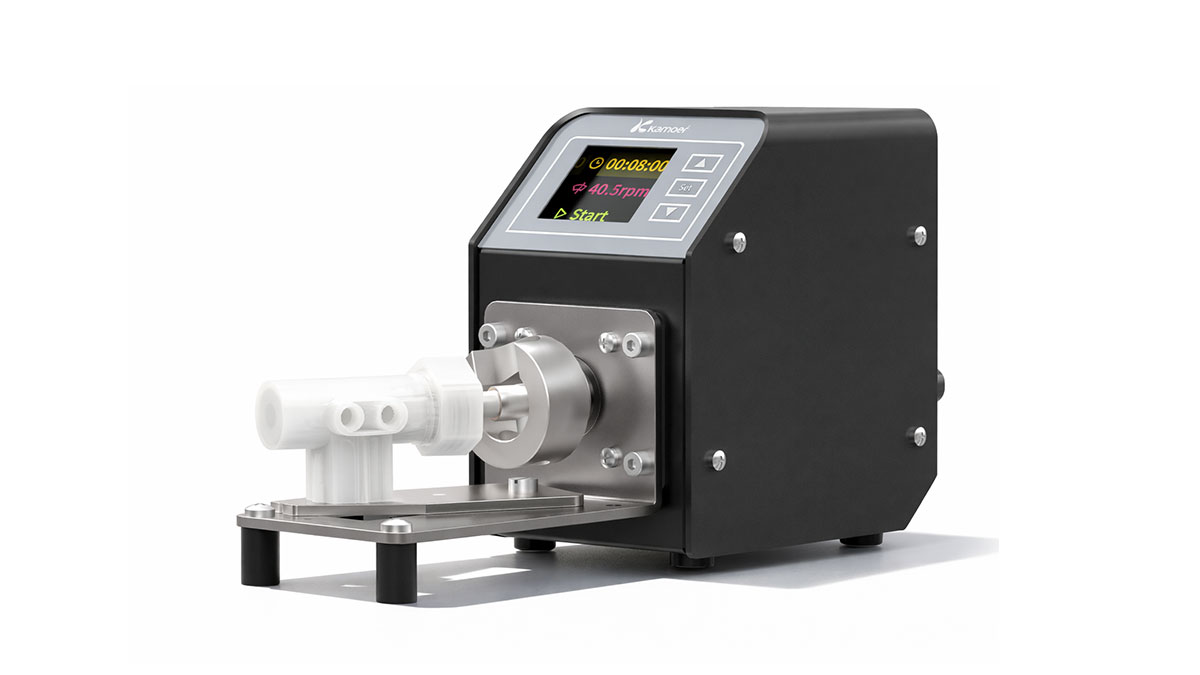
Kamoer has long focused on micro-fluidic transfer and precision control, building solutions around reliability and engineering consistency. The M1-KPVP Smart Ceramic Plunger Pump was created specifically for “harsh media + micro-dosing” lab scenarios.
-
Core Technology: Using “Hard + Stable” to Resist “Corrosion + Drift”
M1-KPVP is designed to turn “usable” into “repeatable and dependable” under corrosive conditions.
1.1 ZrO₂ ceramic plunger: wear resistance for high-frequency dosing
-
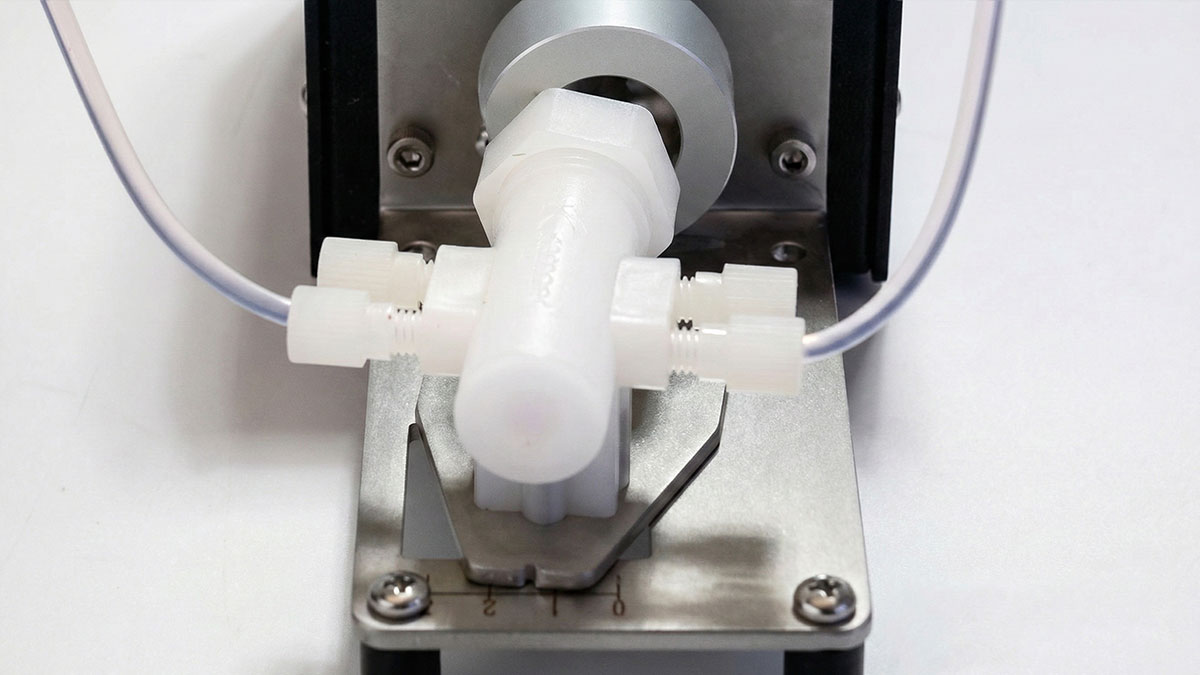
The pump head’s key component uses high-wear-resistant zirconia (ZrO₂) ceramic.
-
Lifetime statement (keep it rigorous): under Kamoer’s internal test conditions, the pump head lifetime can exceed 10 million cycles. Actual lifetime depends on media, temperature, and operating practice.
1.2 PVDF / PTFE / ZrO₂ wetted-parts system: a robust corrosion-resistant foundation
-
Wetted materials include PVDF, PTFE, and ceramic components, offering strong compatibility for many corrosive acids/alkalis and a wide range of solvent systems.
-
Important boundary condition (recommended to keep): chemical compatibility depends on the specific chemical, concentration, temperature, impurities, and duty cycle.
-
Note on HF: Hydrofluoric acid (HF) is not recommended without dedicated compatibility validation and short-term endurance testing.
1.3 Micro-dosing control: turning “hand feel” into “parameters”
-
Micro shot options: 100 μL/shot to 300 μL/shot (with customization potential).
-
Supports calibration and suck-back (anti-drip), reducing dripping and improving repeatability and cleanliness.
-
Application Focus: Three High-Value Lab Scenarios (with Typical System Schematics)
Because M1-KPVP is built for micro shots + harsh media tolerance, it fits lab workflows that demand “settable, repeatable, and controllable” dosing.
Scenario 1: Precision dosing of highly corrosive reagents (strong acids/alkalis, reactive catalysts)
In chemical synthesis and materials preparation, researchers often need to dose concentrated sulfuric acid, strong alkali solutions, or highly active catalysts in controlled micro amounts to maintain consistent reaction pathways and batch comparability.
Pain points
-
Manual pipetting/dripping increases operator exposure risk; repetitive dosing over time introduces volume fluctuations that degrade reproducibility.
-
Traditional comparable products can suffer seal aging, leakage, sticking, or instability under corrosive media—causing downtime and data drift.
M1-KPVP solution
-
PVDF / PTFE / ZrO₂ wetted system: provides a more stable corrosion-resistant foundation for many strong acids/alkalis (verify against chemical, concentration, and temperature).
-
Calibration + suck-back: helps establish “settable and repeatable” dosing steps while reducing drip risk.
-
IP66 pump head protection: better suited for lab bench splash/cleaning environments, reducing the likelihood of external ingress-related failures.
(Note: IP rating is environmental protection, not chemical corrosion resistance; corrosion resistance is determined by wetted materials.) -
HF statement: HF and other special media require dedicated compatibility evaluation; not recommended for routine use without validation.
Typical system schematic (text)
-
Reagent bottle (acid/alkali/catalyst)
→ inlet tubing (PTFE-class; keep short)
→ M1-KPVP (shot dosing; enable suck-back)
→ dosing needle/drip tip (corrosion-resistant)
→ reactor flask / vessel / micro-reactor
→ (optional closed loop) sensor (pH/temperature) → controller/PC → RS485 dosing command
Implementation tips
-
Use shot dosing as the smallest “recipe unit” (100/200/300 μL) and calibrate after media change.
-
Keep the dosing tip above the liquid surface when possible to reduce siphoning and splash exposure.
-
Use secondary containment and perform corrosive/volatile dosing inside a fume hood.
Scenario 2: Micro-transfer of volatile solvents and complex solvent systems (long-run stability)
Organic chemistry and materials labs frequently handle solvent dosing over extended periods—where long-run consistency matters more than short-term flow.
Pain points
-
Common elastomers and soft materials may swell, age, or leak, causing flow drift, clogs, or frequent maintenance.
-
Long dosing sequences can become inconsistent “front vs. back,” impacting kinetics and process window studies.
M1-KPVP solution
-
PTFE sealing + ceramic plunger architecture improves durability and consistency for many solvent systems (verify per solvent type and temperature).
-
Stepper-driven precision + micro shot dosing supports repeatable long-duration addition protocols.
-
For unknown mixed solvents or highly oxidative chemicals (e.g., highly concentrated nitric acid), treat as “special media”: confirm compatibility and validate before long-run operation.
Typical system schematic (text)
-
Solvent bottle (sealed cap, minimized evaporation)
→ PTFE-class inlet tubing (short, low dead volume)
→ (optional) inlet micro-filter (if particulates/precipitation possible)
→ M1-KPVP (continuous mode or shot-based scheduling; periodic calibration)
→ fine dosing needle / drip line
→ reaction vessel (often with stirring)
→ (optional feedback) balance (gravimetric dosing) → PC → RS485 control
Implementation tips
-
Use sealed bottles and short tubing to reduce evaporation-driven variability.
-
For maximum repeatability, prefer “shot + cadence” dosing rather than purely continuous dosing.
-
Validate compatibility for unknown solvent mixtures and oxidizing systems.
Scenario 3: Frontier energy research—pouch-cell electrolyte filling (dose consistency + cleanliness)
For university and institute battery teams, electrolyte filling is a critical step that strongly influences cell consistency.
Pain points
-
Electrolytes can be corrosive and are sensitive to moisture and impurities; some systems can leave residues or crystallize, increasing instability risk.
-
Manual filling is difficult to standardize across batches, complicating comparisons and optimization.
M1-KPVP solution
-
Shot-based dosing supports parameterized, repeatable electrolyte filling protocols for small-scale process verification.
-
Plunger-based dosing approach reduces dependence on valve mechanisms, lowering uncertainty associated with valve sticking in demanding media.
-
Critical prerequisite: implement a cleaning SOP and keep the ceramic kit surface clean—especially for sticky or crystallizing media—to reduce drift and sticking.
-
Media rule: avoid particulates; filtration/clean handling improves lifetime and consistency.
Typical system schematic (text)
-
Electrolyte bottle (sealed; ideally dry environment / glovebox as required)
→ low-extractable inlet tubing (short)
→ (optional) filtration or settling to reduce particles
→ M1-KPVP (shot dosing; calibrate; enable suck-back)
→ filling needle/nozzle (aligned with fixture)
→ pouch-cell fixture / tooling (positioning, splash control)
→ (optional process orchestration) PC/PLC schedules vacuum/soak/dosing → RS485 control
Implementation tips
-
Use shot parameters to standardize fill volume across batches.
-
Establish “use-then-flush/clean” SOP to prevent residue-driven drift.
-
Control moisture exposure and maintain clean, closed handling.
-
Smart Operation: Built for Lab Space and Platform Integration
-
Compact footprint: 84 × 216 × 124 mm; approx. 1.5 kg—easy to deploy on benches or inside fume hoods.
-
Visual interface: 1.8-inch color screen with simplified buttons for quick setup and monitoring.
-
Flexible control options:
-
Local keys, RS485 communication, and foot switch triggering (as applicable)
-
GX16-4 connector supports integration and multi-device setups
-
-
IP66 pump head protection supports splash-prone bench environments.
-
Lab Best Practices (Professional, Trust-Building Notes)
-
Compatibility first: confirm chemical compatibility for strong oxidizers, unknown mixtures, and special media; validate under actual concentration and temperature.
-
No particles: avoid particulate-laden fluids; add filtration if needed.
-
Clean after use: flush and clean promptly; sticky/crystallizing media require a strict SOP.
-
Safety workflow: corrosive/volatile dosing should be performed in a fume hood with secondary containment.
-
Conclusion: A Reliable Partner for Repeatable Micro-Dosing in Harsh Media
Scientific progress depends on minimizing uncontrolled variables. M1-KPVP combines a ZrO₂ ceramic plunger and PTFE sealing with micro shot dosing, calibration, suck-back anti-drip control, and RS485 connectivity—delivering a corrosion-resistant precision dosing solution built for university laboratories.
As Kamoer continues to advance micro-fluidic control, we remain committed to reliability—so every dosing step can be repeatable, traceable, and safer.
Related Products